The Call of The Karoo: Fossils
Follow Along…
I remember my mother, Bella, telling me that the Karoo was once a lake, and reminiscing about a fish fossil her grandfather, Jurie Laubscher, discovered in the early 1900s on Spandou Kop near Graaff-Reinet. A friend later gifted me a ceramic piece with the words “Die Karoo was eens ’n oseaan”, which reignited my desire to explore this narrative.

The Karoo: A Window into Prehistoric Life
The Karoo is one of the most important fossil localities in the world. Over 200 million years ago, South Africa formed part of the southern reaches of Pangaea, and the Karoo holds a largely unbroken record of prehistoric life extending from the Permian to the Jurassic periods.

Fossil Highlights

The fossil above is Atherstonia scutate. It was collected by R.U. Mutter in 1970 near Nieu-Bethesda and is at least 250 million years old.

The story of the fish fossil led me to the Paleontology Department at Wits University and the brand-new Karoo Origins Fossil Centre in Graaff-Reinet. I met multiple paleontologists, including Dr Bruce Rubidge and Dr Jonah Choiniere, whose knowledge and dedication to the field are deeply inspiring. It has been an incredible experience and a privilege to delve into research and conservation alongside such passionate experts.
Some specimens in these collections date back 200–350 million years.
These discoveries added a unique layer to our product development and deepened our love for this exceptional biosphere.
From Semionotus to Horsetails


The Semionotus fossil above was discovered by the Kitching brothers in 1946. Although this specimen was found in the sandstone of the Clarens Formation and dates back 190 million years, it belongs to the Semionotiformes group, whose closest living relatives are the gars.


The fossil above is a horsetail plant called Phyllotheca australis. Dating from the late Permian period, it was common in wetlands, where its above-ground stems and underground rhizomes (which resembled the stems) served as a staple food source for herbivores - much like grass does today. Its living relative is Equisetum.
Honouring the People Behind the Fossils
Our beautiful Call of the Karoo range also celebrates the researchers and historians - the custodians of this heritage - who reveal and preserve the treasure of fossil species in our country.

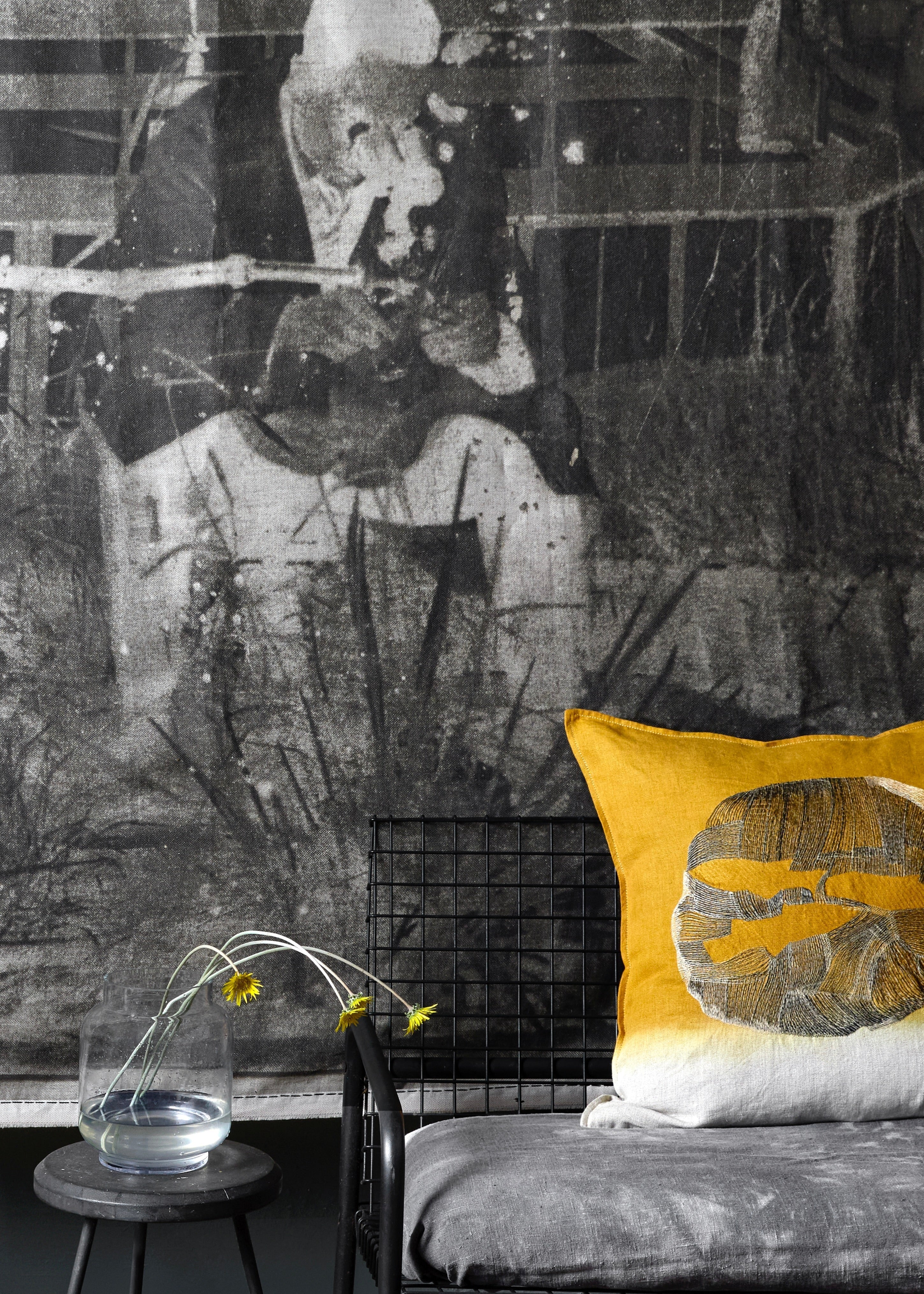
Above: Wall art panel - Microscope Man - honouring past and modern-day researchers who document and protect our fossils, fauna, and flora.

The fossil on the right is a skeleton of the dinosaur Massospondylus, collected on Naude’s Nek by Wits PhD student Bailey Weiss. Local farmer Juan-Marie Naudé discovered it on a road near her farm, Vrederus.
The fine lines embroidered on our fossil cushions pay tribute to the careful work of the technicians who prepare these fossils. Their meticulous process - stabilising, engraving, brushing, and cleaning each relic - blends precision with a kind of tenderness.


Celebrating Heritage and Memories
These items form part of our range, The Call of the Karoo, celebrating my darling mom Bella’s heritage and memories in her 90th year.

SHOP THE FULL COLLECTION